Road maintenance and road rehabilitation with roxit
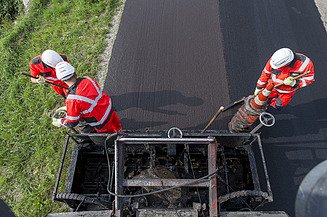
Roads need to perform – safely, resiliently, economically and, where possible, without long closure periods. For local authorities, businesses and infrastructure operators, this means above all: prioritising maintenance over new construction wherever technically feasible.
Preservation over new construction
This is exactly where we come in. roxit stands for economical, material-preserving and technically robust road maintenance methods based on bitumen emulsions from our own production that are precisely customised to the respective requirements. Our clear priority is preservation over full rehabilitation or new construction, as long as the existing structure permits it. roxit specialises in crack repair, joint sealing, edge treatment, impregnation, milling, cold thin-layer applications and the production of surface treatments. We use state-of-the-art processes that extend the service life of existing traffic surfaces. This delivers the following benefits for our clients:
- short construction times
- economical solutions
- long-lasting results
- plannability and technically transparent decisions
Whether for road construction, maintenance or rehabilitation: we support you in operating infrastructure in a sustainable and budget-conscious manner.
Our expertise in road construction
For clients, it is essential that road construction and rehabilitation measures can be planned and executed from a single source. Coordination effort is reduced, interface risks are minimised and reliable processes are ensured as a result. This is precisely where we excel: we support projects from initial analysis through to long-term maintenance and preservation.
Specialisations of roxit
Many providers in the road construction sector focus on new construction or asphalt works alone. Our strengths go beyond that, covering areas that are particularly important for infrastructure preservation:
Bitumen emulsion-based preservation methods
These methods enable cost-effective rehabilitation with short closure times. For clients, this means that roads remain usable for longer without requiring full reconstruction.
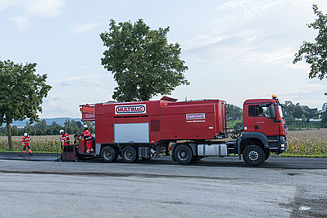
Jointing technology, Patchmatic, Multimac® (DDK/DSK), SAMI, fleece laying
These specialised methods address typical damage patterns at an early stage, prevent water ingress and significantly extend the service life of road infrastructure. They are particularly valuable for municipal networks and heavily used traffic areas.
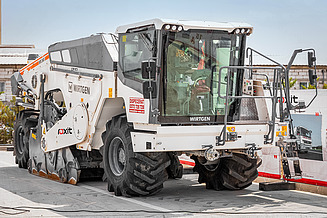
In-house equipment fleet
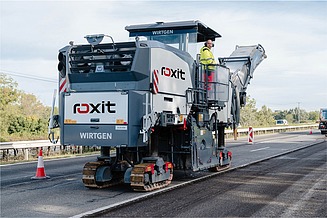
With milling machines, DDK/DSK laying equipment, surface treatment machines, repair trains and joint cutters, we can work flexibly, fast and with high precision. This reduces waiting times, enables short-notice execution and ensures high-quality workmanship. The result is a clear benefit for our clients: solutions that perform reliably over the long term – technically, economically and organisationally.
Use of modern processes and resources
With our efficient solutions and technologies, we enable economical road maintenance with minimal intervention and a long lifespan.
Multimac® (DDK/DSK), surface treatment and joint remix
Modern preservation methods such as Multimac®, DDK/DSK, surface treatment and joint remix allow for fast and economical road rehabilitation with minimal traffic impact. For clients, this means fewer closures, lower costs and a significantly extended service life of existing infrastructure. Thin-layer systems such as DDK/DSK (Multimac®) level out rutting, improve skid resistance and reliably seal the surface without requiring extensive structural renewal. Surface treatment provides additional protection against water ingress into the existing road structure. Additionally, joint remix is used to thermally treat damaged sections at an early stage and reintegrate them into the road structure. This allows near-surface defects to be repaired economically without full reconstruction of the entire road surface.All methods can be applied flexibly and are particularly suitable for municipal networks, rural roads and heavily used traffic areas where rapid reopening to traffic is critical.
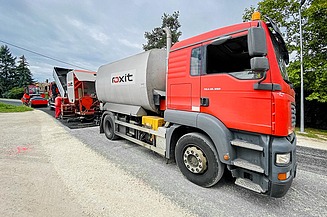
Combination of DDK/DSK + surface treatment: maximum effect in one operation
For road sections with complex damage patterns, roxit combines cold-applied thin overlay (DDK) and surface treatment (OB) in a coordinated composite method. The DDK/DSK layer levels out deformations and unevenness; the surface treatment applied on top seals the pre-profile and improves the skid resistance of the surface layer. Compared to using either method alone, this combined approach also addresses structural weaknesses that a surface treatment alone cannot resolve – while remaining more cost-effective than a full rehabilitation. This composite method has proven particularly effective on municipal roads and rural roads with pronounced rutting and incipient cracking.
Hydrated lime and milk of lime for better construction-site trafficability
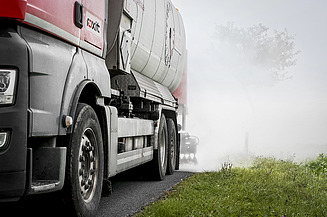
When pre-spraying bitumen emulsion on the roadway, there is a risk that the freshly applied emulsion may be displaced by vehicles driving over it or lose its adhesive strength. roxit prevents this by spraying milk of lime directly over the applied emulsion layer. The hydrated lime acts as a separating agent, allowing the surface to be driven over during ongoing construction works, prevents contamination and preserves the adhesive strength of the emulsion for subsequent layer build-up.
Bitumen emulsion for post-treatment and evaporation protection
Base layers stabilised with binders must be sealed with evaporation protection immediately after compaction. This task is performed by bitumen emulsion from roxit. Without targeted protection, the surface may dry too quickly, which negatively impacts strength development and material properties. roxit therefore applies evaporation protection agents to the surface immediately after paving. They form a temporary protective film that controls moisture loss, stabilises curing time and ensures the desired material parameters. This method is particularly relevant in hot weather conditions, windy environments or large exposed areas.
Bitumen emulsions: in-house production ensures consistent quality and availability
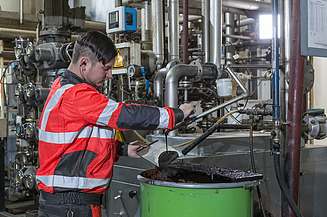
The in-house production of bitumen emulsions at roxit ensures consistently high quality across preservation applications such as Multimac® (DDK/DSK), surface treatment or pre-spraying. This provides reliable product properties, repeatable results and project execution that remains independent of supply bottlenecks or fluctuations in material quality. Close coordination between the laboratory, production and construction site allows emulsions to be precisely tailored to the substrate, temperature and application method. More details on properties, types and areas of application can be found in the section covering our bitumen emulsions.
Joint and edge treatment: securing long-term layer bond integrity
Construction joints and edge transitions are critical weak points in any asphalt structure. If not treated properly, water can penetrate, accelerating layer degradation through freeze-thaw cycles and leading to isolated defects that may develop into more extensive structural damage. roxit treats construction joints and edges by applying the required amount of binder directly to the paved asphalt layer. STARPLAST® PM, a material specifically developed for this purpose, is used to improve adhesion and supplement the binder at the connection point. The material is applied using purpose-built equipment – after application, the next layer can be placed. The result: tight, adhesive joints and edges that secure interlayer bond integrity throughout the entire pavement structure.
Impregnations
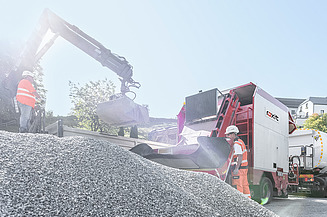
Penetration treatment is used in selected countries on lower-category roads and on specially constructed paths and surfaces. The process creates base layers from aggregates with a grain size of up to 63 mm by hot asphalting and is particularly well suited for cases where the economical construction of load-bearing foundations is required. The constructed base layer is usually sealed with a two-layer asphalt surface. The result is a resilient, durable structure, even in locations with difficult substrate conditions. Typical areas of application: rural roads, industrial service roads, access roads, areas with substrates that are not fully stabilised.
Machinery and technical equipment
Our efficiency in road construction and road rehabilitation is built on a fleet of modern machinery, which includes the following production resources:
- Milling with various working widths (including 3D levelling)
- Multimac® (DDK/DSK) for thin-film systems
- Wide-spray equipment for bitumen emulsions and specialised equipment for flank coating
- Joint cutters and grouting equipment
Our innovative technical equipment enables:
- precise execution
- short construction times
- economical execution of even large-scale projects
Sustainability through preservation of existing infrastructure
Our processes are designed to preserve existing infrastructure rather than replace it, reducing resource consumption and environmental impact:
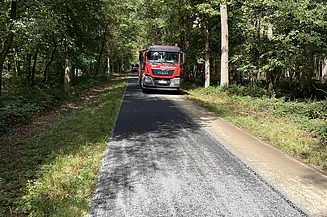
- Rehabilitation instead of new construction, wherever technically feasible
- Cold construction methods with reduced energy consumption
- Recycling asphalt and building materials to conserve resources
- Biodiversity and ecosystems (obligation to assess environmental impact as early as the planning phase, selection of environmentally responsible methods, implementation of mitigation and compensation measures)
- Occupational safety and social responsibility
- Digitalisation to optimise processes
- EU taxonomy-compliant ESG processes
Certified quality, safety and sustainability in road construction and civil engineering
For you as the client, it is essential that road construction and rehabilitation measures are carried out in a demonstrably safe and quality-tested manner. roxit operates one of the most comprehensive management systems in the industry. The majority of our units are certified according to ISO 14001 or registered under EMAS (Eco-Management and Audit Scheme), which goes beyond ISO 14001 and imposes stricter requirements in terms of transparency, legal compliance and employee participation. This involves regular audits to ensure, among other criteria, transparent environmental indicators and continuous improvement of standards on construction sites and at workplaces. In addition, ISO 9001 (quality), ISO 45001 (occupational health and safety) and ISO 50001 (energy management) ensure reliable and standards-compliant execution in selected roxit units. For our clients, this means transparent standards, documented processes and a high level of safety in planning and execution.
Key facts and figures
Important company facts and performance metrics at a glance:
Machinery
- milling machines
- BSG units (for wide spraying)
- Multimac/OB units
- RC units
- pavement saws
- cold mix systems
- lorries equipped with loading cranes
Our references as a road construction company and specialised partner in traffic route construction
For our clients, reliable timelines, clear communication, transparent technical solutions and long-term serviceability of traffic areas are essential. In addition, they expect cost-efficient project delivery and streamlined execution from a single source.-
Our reference projects include
- Rehabilitation of municipal road networks using DDK and surface treatment
- Restoration of heavily trafficked industrial and logistics areas
- Development of commercial and residential areas
- Spot repairs using Patchmatic and crack repair applications
- Traffic route construction projects with high requirements for availability and quality
-
Typical projects and use cases:
- Road and motorway repair and rehabilitation: repair of cracks, joints and pavement edges to extend the service life of asphalt layers.
- Road recycling (cold on-site): full surface renewal without material removal, ideal for rural roads, industrial areas or lightly trafficked roads.
- Lime soil stabilisation for transport infrastructure: improving substrate load-bearing capacity for applications such as new roads, roundabouts or bridge embankments.
- Concrete surface segmentation and maintenance: logistics centres, airport taxiways, freight transport parking areas.
- Soil stabilisation for building foundations: treatment of weak substrates under halls, warehouses, industrial facilities or administrative buildings.
- Concrete surfaces in industrial areas: segmentation and repair of concrete surfaces in industrial areas, warehouses and production facilities.
Selected reference projects
Our projects – from planning to execution
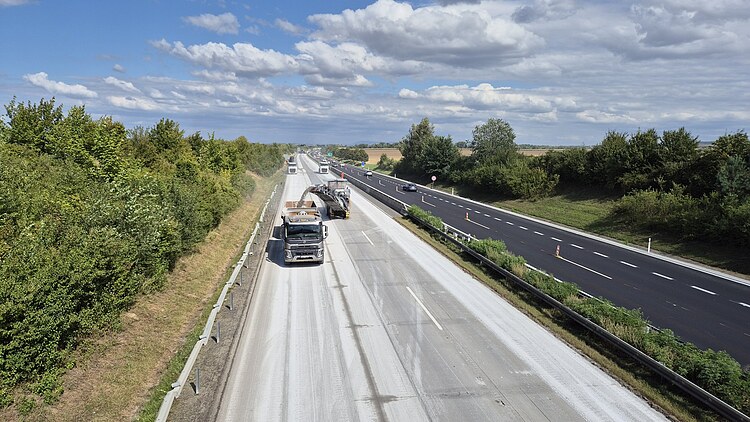
Motorway D1 – repair of CB road V km 241.5 to 246 L+R, Czech Republic
Milling of asphalt and concrete layers as part of the D1 motorway project
Client: Strabag a.s. Olomouc Ing. Vašíček
Construction time/performance period: August 2025 –16 days
Order volume: 8,041 m3 at a depth of 8.5 cm – milling
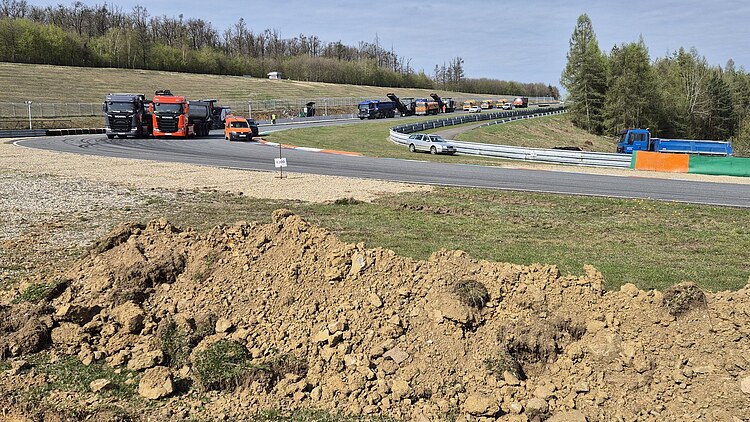
Brno - Masaryk Ring
Three two-metre milling machines were used, controlled by the "SmoothRide" system as well as 3D milling technology.
Client: Strabag a.s. PJ Brno Ing. Igor Janča
Construction time/performance period: April 2025 - 16 days
Order volume: 82,228 m² at a depth of 6.5 cm + 9,152 m² at a depth of 4.5 cm
Preserving existing roads rather than building new ones?
Contact us for project-specific advice, an assessment of rehabilitation vs. new construction or a non-binding offer for road construction, asphalt works or road refurbishment.
Inquire nowFrequently asked questions (FAQ) about road maintenance
-
When does it make more sense to rehabilitate a road than to build a new one?
Road maintenance/road rehabilitation makes more sense than new construction if the base layer is still intact and only the surface is damaged. In such cases, a maintenance measure can significantly extend service life while reducing costs and closure times.
-
How long do road maintenance works take?
This depends on the scope and method used. Many maintenance measures (such as thin-layer technology or Patchmatic) can be completed in a short time, allowing traffic areas to be reopened quickly.
-
What impact do these methods have on the environment?
By preserving existing infrastructure, using cold construction methods and recycling processes, energy consumption and CO2 emissions are reduced. At the same time, the infrastructure’s service life is extended.
-
Which types of damage can be treated?
- Surface deterioration
- Incipient cracking
- Loss of skid resistance
- Moisture ingress
-
Does roxit provide support for selecting the right measure?
Yes. We assess the condition of the road, the base layer and usage requirements and then recommend an economically viable solution with a clear focus on preservation, wherever technically possible.
-
Which areas of application does roxit cover?
We work in municipal road construction, development projects, traffic route construction, on industrial and commercial sites, car parks, cycle paths and selected motorway sections.
-
Can smaller areas such as courtyards and driveways also be rehabilitated?
Yes. With methods such as Patchmatic, cold asphalt and surface treatment, even smaller areas can be repaired economically.
-
What role does asphalt construction play at roxit?
We perform pre-spraying work for layer bonding in asphalt road construction.
-
How do I find the right contact person?
roxit’s regional structure provides you with local contacts in your area. Upon request, we will connect you directly with the right contact for your road construction or road rehabilitation project.