Concrete for your project
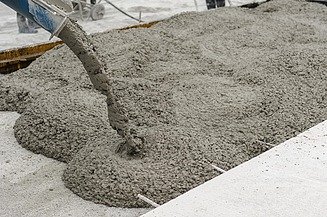
Concrete is one of the most important building materials in the modern world. For more than 150 years, almost every permanent human-made structure has relied on concrete. Buildings, roads, bridges, industrial facilities and underground structures all depend on it. As a building material, concrete combines high load-bearing capacity and durability with exceptional design flexibility, making it the indispensable foundation of modern infrastructure and architecture.
What is concrete?
Concrete is a precisely engineered, standardised product made from natural raw materials. It consists of a mixture of cement, aggregates and water. Fresh concrete can be moulded into almost any shape for a limited time after mixing. It then hardens permanently through chemical and physical processes, even underwater. This unique property allows us to bring architects’ designs for both exterior and interior spaces to life. Below, we explain what concrete is made of, how the individual components determine its properties, and why roxit concrete is the right choice for your construction project.
The composition and function of concrete
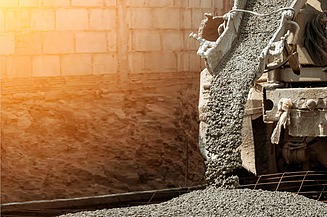
Concrete is made up of three basic components: aggregates, binder and water. The aggregates – typically sand and gravel or crushed stone – determine the particle size distribution, bulk density and mechanical properties of the concrete. The primary binder in concrete is cement. Combined with water, it forms the cement matrix that permanently binds the aggregate particles together. Water activates the cement hydration process and directly affects its strength and workability.
Use of admixtures and additives
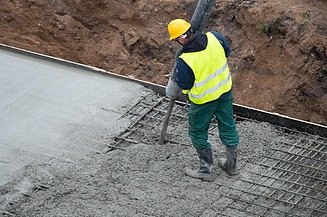
Concrete may also contain admixtures. These are mainly liquid chemical agents used to control workability, setting time or frost resistance. Admixtures such as fly ash, granulated blast furnace slag or limestone can partially replace cement, improving the durability of the concrete while reducing CO₂ emissions. As concrete has high compressive strength but very low tensile strength, steel reinforcement is embedded into structural elements subject to bending loads in order to achieve the necessary load-bearing capacity. The resulting composite material is called reinforced concrete.
Physical and mechanical properties
Key properties of concrete include compressive strength, tensile and flexural strength, bulk density, consistency, permeability, chloride absorption and heat of hydration.
- Compressive strength defines the load-bearing capacity of concrete and is specified by strength classes.
- Tensile strength and flexural tensile strength influence crack behaviour and the bond between concrete and reinforcement.
- Bulk density affects the weight and shielding properties of concrete; heavy concrete has a significantly higher bulk density.
- Consistency determines workability and is specified by consistency classes (F1 to F6).
- Permeability and chloride absorption determine the risk of reinforcement corrosion.
- Heat of hydration must be considered when constructing large structural elements.
Concrete typically remains workable for approximately 90 to 120 minutes after mixing. Temperature, admixtures and transport times can all affect this timeframe.
Exposure classes and durability
Exposure classes define the environmental conditions to which concrete will be subjected and determine requirements for mix design, concrete cover and curing. Relevant exposure classes include carbonation, chloride exposure from de-icing salts, seawater, freeze-thaw conditions and chemical attack. These factors must be considered during the design phase to achieve the best possible concrete performance for each project.
Concrete applications
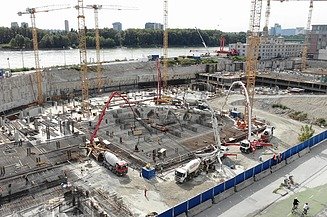
Concrete is a versatile building material that can be used in a wide range of applications, depending on the specific formula tailored to each project. Typical applications include:
- Foundations
- Floor slabs (residential construction)
- Screeds and interior flooring
- Ceilings and columns (building construction)
- Dämmer, fluidised soil (civil engineering)
- Bored piles, diaphragm walls (specialised civil engineering)
- Industrial floors and parking structures
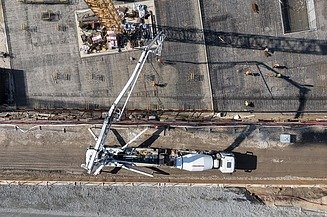
- Bridges and traffic areas
- Road construction and pavements
- WU (waterproof) structures (white tank)
- Tunnelling and civil engineering
- Abutments, superstructures, caps, fire protection using fire-retardant fibres (civil engineering)
- Exposed concrete and architectural surfaces
- Heavyweight concrete (radiation shielding, counterweights)
- Lightweight concrete (insulation, weight reduction)
- Self-levelling screed for underfloor heating / “heating screed”
- Fluidised soil with RC aggregates (at selected plants)
Which concrete for which application?
| Scope of application | Typical strength classes | Recommended consistency | Key requirements |
|---|---|---|---|
| Foundations | C20/25; C25/30 | F2–F4 Load-bearing capacity | Resistance to frost and moisture |
| Floor slabs in residential construction | C20/25 | F2–F3 Low crack formation | Uniform after-treatment |
| Ceilings and columns in building construction | C25/30; C30/37 | F2–F4 Composite structure with reinforcement | Dimensional stability |
| Industrial floors and parking structures | C30/37; C35/45 | F3–F4 High abrasion resistance | Low susceptibility to cracking |
| Bridges and traffic areas | C35/45; C50/60 | F3–F5 Durability | Resistance to freeze-thaw cycles and de-icing salts |
| Road construction and pavements | C30/37; C35/45 | F3–F4 Long-term load-bearing capacity | Antifreeze |
| WU (waterproof) structures (white tank) | C25/30; C30/37 | F2–F4 Water resistance | Low permeability |
| Tunnelling and civil engineering | C30/37; C35/45 | F3–F5 Vibration reduction | Durability |
| Exposed concrete and architectural surfaces | C20/25; C25/30 | F4–F6 Surface quality | Demoulding and after-treatment |
| Heavyweight concrete for radiation protection | C35/45; C50/60 | F3–F5 High bulk density | Special aggregates: (barite) |
| Lightweight concrete for LC (light) insulation | F2–F4 Low weight | Thermal insulation | |
| Drainage and permeable concrete | C12/15; C20/25 | F1–F3 Permeability | Frost resistance |
| Recycled concrete and R-concrete | C20/25–C35/45 | F2–F4 Aggregate quality control | EPD certificate |
| Self-compacting concrete (SCC) | C20/25–C35/45 | F6 Placement without vibration | High-density reinforcement zones |
| Screeds and interior flooring | C12/15; C20/25 | F2–F3 Flatness | Rapid accessibility |
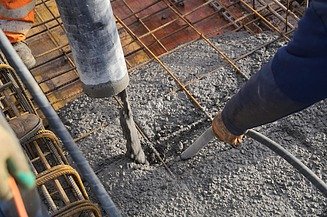
Speciality concretes and additives
In addition to conventional concrete, a range of speciality concretes and additives are used at selected plants. These include:
- Self-compacting concrete (SCC) for dense reinforcement and exposed surfaces
- Fibre-reinforced concrete for improved crack control and increased toughness
- Heavyweight concrete containing barite or magnetite for radiation shielding and counterweights
- Lightweight concrete and polystyrene concrete for insulation and reduced structural weight
- WU (waterproof) concrete for watertight structures
- Recycled concrete incorporating aggregates returned to the material cycle to conserve resources
- Screeds and anhydrite screeds for interior floors and levelling layers
Why us? What makes roxit concrete special?
roxit is a leading manufacturer of ready-mixed, precast- and special-purpose concrete, known for its strong regional presence and reliable delivery performance. Our solutions are designed for construction companies, planners, public sector clients and private builders, and include expert advice on concrete selection, coordinated pumping logistics and transparent quality documentation.
Finished products for demanding construction projects
In addition to producing fresh concrete and special-purpose concretes, roxit also offers high-quality precast products for complex construction projects and temporary site solutions. These include tunnel segments, which ensure high precision, dimensional accuracy and structural load-bearing capacity in tunnel construction. For flexible, reusable structures, we supply concrete blocks and modular block systems. They are ideal for retaining walls, storage units, partition walls and temporary structures.
Concrete delivery
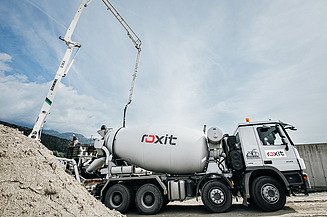
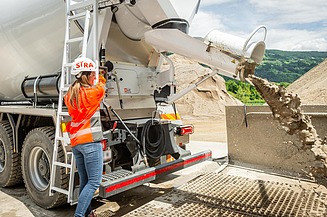
roxit delivers ready-mixed concrete using a 4-axle truck mixer. At the jobsite, the concrete is unloaded from the truck via the discharge chute. The standard chute reach is up to 2.5 metres from the rear of the vehicle. If this distance is insufficient, the chute can be extended to a maximum of 6 metres using a discharge pipe, provided there is adequate height difference to ensure proper flow. Using a discharge pipe incurs additional costs. To improve workability on the jobsite, a superplasticiser can typically be added at the point of use. This also incurs additional costs, but significantly improves handling and placement of the concrete.
Reference projects
Proven in practice: our concrete solutions in real-world applications
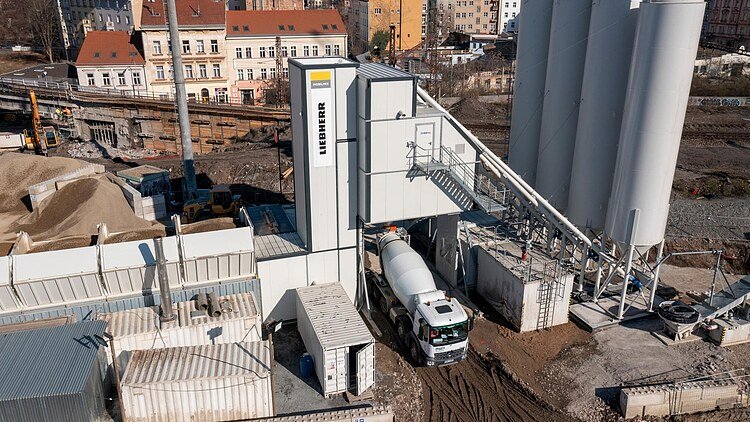
Campus Česká Spořitelna, Prague
Ready-mixed concrete – mobile concrete mixing plant directly on site
Client: STRABAG a.s.
Construction period/performance period: 2024 to 2026
Order volume: 81,500 m3
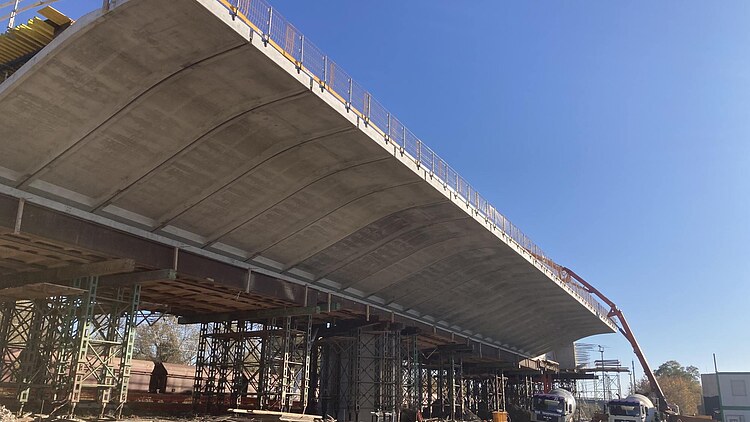
D35 motorway – swing bridge
Ready-mixed concrete
Client: Mi Roads + Doprastav
Construction period/performance period: 2023 to 2025
Order volume: 30,000 m3
Challenge: The first swing bridge in the Czech Republic, spanning the Prague-Česká Třebová railway corridor. The structure crosses a six-track railway line and is 26.7 metres wide. A total of 3,150 m³ of concrete was supplied for construction of the bridge.
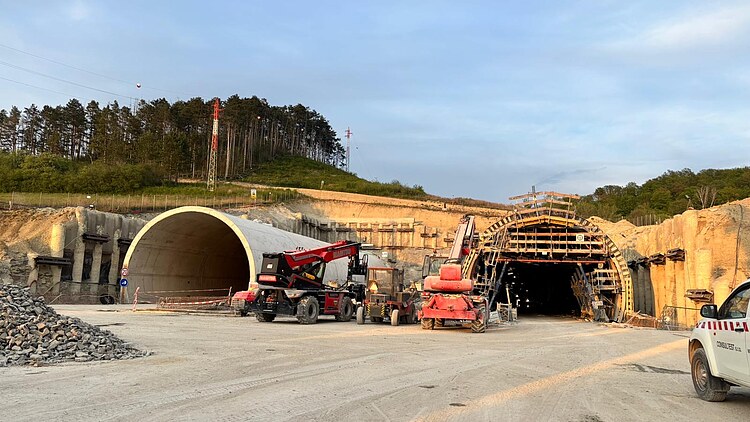
D35 motorway – “Homole” tunnel
Client: EUROVIA CZ, Marti and EUROVIA SK consortium for roads and motorways of the Czech Republic (ŘSD)
Construction period/performance period: 2025 to 2026
Order volume: 50,000 m3 of concrete
Challenge: The Homole tunnel consists of two single-carriageway tubes, approximately 525 and 570 metres in length. Due to its technical complexity, the project ranks among the country’s most significant tunnel construction projects.
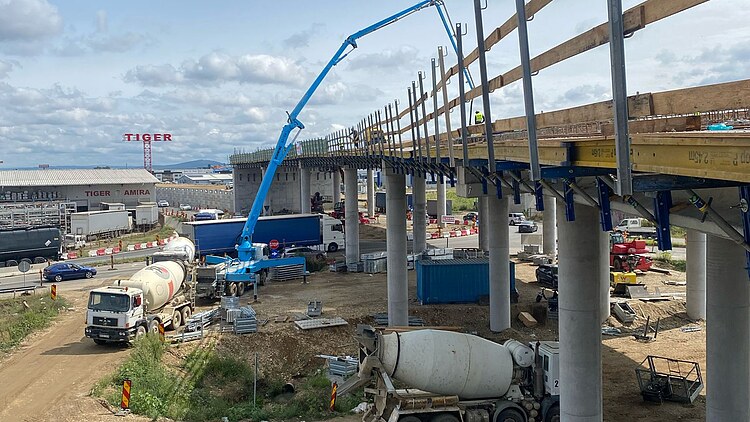
BYPASS ORADEA Dex16
Concrete for motorway construction
Client: STRABAG
Construction period/performance period: March 2022 to March 2024
Order volume: 84,000 m³
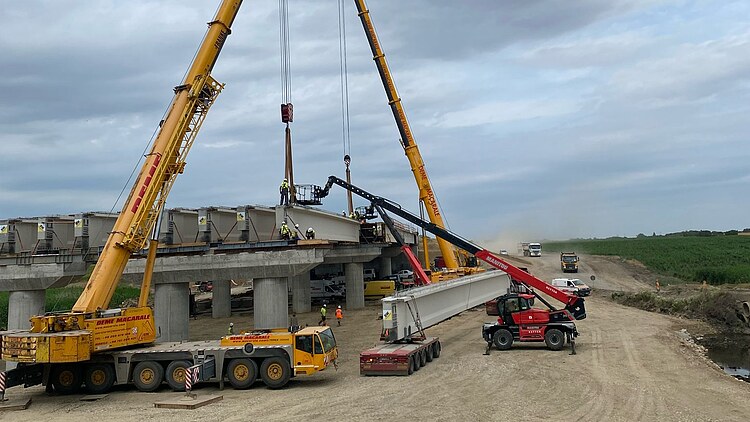
A7 motorway, Ploiești – Buzău: Section 1, Dumbrava – Mizil
Concrete for motorway construction
Client: RETTER PROJECTMANAGEMENT SRL
Construction period/ performance period: March 2022 – March 2024
Order volume: 46,000 m³
Key figures for roxit
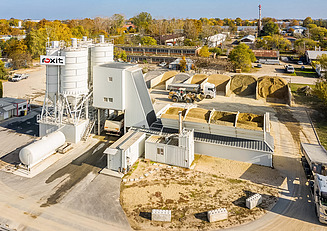
- 116 concrete mixing plants in 12 countries
- Annual production of 3,100,000 m³ of concrete (as of 2025)
Technical details and specifications
-
Our product range includes:
- Ready-mixed concrete
- Precast concrete
- Fresh concrete
- Screed concrete
- Cement screed
- Anhydrite screed
- Exposed concrete
- WU (waterproof) concrete
- Steel-fibre-reinforced concrete
- Structural concrete
- Bridge concrete
- Road concrete
- Self-compacting concrete (SCC)
- Easily compactable concrete (SDC)
- Lightweight concrete
- Heavyweight concrete
- Recycled concrete
- Drainage concrete
- FB BLOCK
- Backfill material
- Cement slurries
-
Strength classes
Compressive strength is one of the most important properties of concrete. Based on its compressive strength, which is measured using a specific method, concrete is classified into different strength classes. The letter C in the designation stands for concrete. As part of the harmonisation of European standards, concrete strength classes have been standardised across Europe in the current generation of standards.
- C12/15: lightweight foundations, non-load-bearing structural elements
- C20/25: floor slabs, foundations
- C25/30: load-bearing structural elements, slabs
- C30/37: higher loads, civil engineering
- C35/45: bridges, traffic areas
- C50/60: high-performance applications
-
Consistency classes / flow spread
A key property of fresh concrete is its consistency. In concrete technology, consistency describes the workability, compactability, pumpability and placeability of concrete. Fresh concrete is classified into consistency classes using different testing methods. At roxit, we use the flow spread classes F1–F6 for our tests:
- F1: flow spread ≤ 340 mm – stiff
- F2: flow spread 350–410 mm – plastic
- F3: flow spread 420–480 mm – soft
- F4: flow spread 490–550 mm – very soft
- F5: flow spread 560–620 mm – flowable
- F6: flow spread 630–700 mm – highly flowable
-
Exposure classes and durability
Concrete properties are determined according to exposure classes XC, XD, XF, XA and XS, as specified in EN 206 and national regulations. Exposure classes categorise the environmental conditions concrete will face, and concrete cover and after-treatment requirements are adjusted accordingly to meet the requirements of the relevant exposure class.
-
Mix design components
- Sand
- Gravel/crushed stone
- Cement matrix
- Additives (superplasticisers, retarders, accelerators)
- Admixtures (fly ash, slag)
Formulations are developed using technical expertise and validated through laboratory testing.
-
Solutions for special requirements
- Concrete resistant to freeze-thaw cycles and de-icing salts
- Low-chloride concrete formulations
- Heavyweight concrete for radiation shielding
- WU (waterproof) concrete for white tank construction
- Self-compacting concrete (SCC)
- Easily compactable concrete (SDC)
-
Standards-compliant ready-mixed concrete
roxit supplies ready-mixed concrete for general building and civil engineering applications, produced in compliance with applicable standards and technical regulations. It covers all standard strength, consistency and exposure classes and is suitable for load-bearing and non-load-bearing structural elements, including foundations, slabs, columns, walls and floor slabs. Production, delivery and quality assurance are carried out following clearly defined requirements.
What clients particularly appreciate about roxit
- Consistently high quality, achieved in part through our in-house laboratories
- On-time, precisely schedule deliveries, even for time-critical concrete pours
- Hands-on, application-focused advice
- Coordinated logistics and pumping services from a single source
- Transparent, digital workflows (e.g. delivery notes, documentation)
How the collaboration with roxit works
With roxit, arranging ready-mixed concrete delivery directly to your construction site is simple. Start by contacting us using our contact form. We will then handle the technical coordination of your concrete delivery and work with you to determine the required strength class, exposure class, consistency, maximum aggregate size, chloride content and pumping requirements. Once the mix design has been approved, it is tested in our laboratories and you will receive a delivery note along with the relevant technical data sheets. We will then coordinate the truck mixer and, if necessary, the concrete pump, align scheduling with the site supervisor and the site logistics team, and carry out just-in-time delivery to your jobsite. Do you have any further questions? Please feel free to contact us at any time.
Other building materials and services
In addition to concrete, our product portfolio includes gravel, crushed stone and sand. This allows you to source many of the raw materials required for your construction project from a single supplier. We also provide pumping and transport services to ensure that delivery and placement are completed on time and without any issues. With roxit, you receive both building materials and site logistics from a single source.
Planning a project and need concrete?
We supply the right concrete for your construction project – from selecting the correct type of concrete to technical implementation, we support you every step of the way with expert experience, advice and solutions grounded in proven methods and practical insight.
Inquire about concrete nowFrequently asked questions (FAQ) about concrete
-
What type of concrete and what grade of concrete should I order?
The right choice depends on the type of construction work involved (foundations, floor slabs, columns, etc.) and the specific requirements of your project. If you don’t have all the details to hand, we can offer a brief consultation to help you select the right product and avoid costly mistakes.
-
How far in advance do I need to order concrete to ensure I can pour it on time?
Ideally, concrete should be ordered 1 to 2 days in advance. At a minimum, orders must be placed one day before the planned pour date. Delivery usually takes place within 24 hours, depending on the required volume and project location. We also offer pumping services tailored to your site conditions to ensure fast and efficient concrete placement. If a concrete pump is required, we recommend placing the order 2 to 3 days before the scheduled pour. Short-notice deliveries will be accommodated whenever possible following consultation with our dispatch team.
-
How much concrete do I need for my project, and which factors determine the price?
The basic formula for calculating the required volume of concrete is length × width × height = m³. If a concrete pump will be used, we generally recommend ordering an additional 0.5 m³ to ensure sufficient material is available on site. The price is determined by several factors: concrete grade, quantity, transport distance and additional services (pumping services, admixtures). We provide fast, transparent quotations, tailored to the specific requirements of each individual project.
-
How should I prepare for a concrete delivery?
Access to your construction site must be suitable for lorries with a gross vehicle weight of 40 tonnes. Sufficient space must be provided for setting up the concrete pump and accommodating any additional delivery lorries. You must also ensure there is space available for cleaning the concrete chute(s) and, where applicable, flushing out the pump hopper after the pour.
-
Does the weather matter?
Yes, because concrete is sensitive to temperature. At temperatures below 5 °C, it sets much more slowly and can be damaged by frost. In hot weather, it dries too quickly and cracks can form. Mild weather is ideal for placing concrete.
-
Can I pour concrete in poor weather conditions?
Yes, but only with appropriate precautions. Light rain is typically not a major problem. However, excess rainfall can:
- wash away the surface
- weaken the top layer of the concrete
- result in an uneven surface finish
Solution: Cover the concrete (tarpaulin or plastic sheeting) and protect freshly concreted surfaces. At temperatures below 5 °C, the chemical reaction that causes the concrete to set slows down significantly. In frosty conditions, water within the concrete can freeze and cause permanent structural damage.
Solutions:- Use R cement (r = rapid, i.e. fast-setting)
- Use warm concrete
- Keep the subgrade frost-free
- Cover the concrete surface thoroughly and insulate it
-
Is follow-up treatment necessary?
Yes. Follow-up treatment begins immediately after the concrete has been poured. The concrete needs to be
- protected from sunlight, wind, heat and frost
- kept moist or covered with plastic sheeting
Why? Concrete does not set by drying out, but through a chemical reaction. Without sufficient moisture, it cracks.
-
How much time do I have to work with the concrete on my jobsite?
On average, concrete placement and compaction must be completed within 105 minutes of the initial addition of water at the plant (see the delivery note and the time listed under “Start of loading”). Environmental conditions such as hot or cold weather, can affect the setting process of the concrete. Admixtures can be added to extend the placement window. Please specify this requirement when placing your concrete order. Important: If the concrete appears dry, DO NOT simply add water. Adding water will weaken the concrete, cause it to crack more readily and reduce its overall service life.
-
Can I cancel or reschedule a concrete order?
If a concrete order needs to be cancelled, for example due to weather conditions, please contact our dispatch department at the earliest opportunity. Please note that cancellations may incur charges. Any changes to the scheduled concrete placement time must be agreed with our dispatch department in advance.
-
What do I need to consider when ordering concrete?
It is important that you order the right type of concrete for your specific application. Not all concrete is the same. Foundations or floor slabs, for example, require a different type of concrete than indoor or outdoor areas. If in doubt, simply tell us how the concrete will be used when placing your order and we will select the right concrete for you.
-
What should I do if my fresh concrete is too runny or too soft?
Never add cement or any other binder to the concrete. Instead, leave the concrete as it is and follow the proper after-treatment procedures (keep the concrete moist, cover it, and carefully finish the surface). You should also verify that the concrete was ordered correctly (too “runny” consistency). If the concrete is still in the mixer, contact the concrete plant immediately so the consistency can be professionally adjusted.
-
What is a retarder?
A retarder slows down cement hydration – the chemical reaction between cement and water. As a result, the concrete remains workable for longer, making it easier to transport and place. This is particularly beneficial in high ambient temperatures, where transport distances are long, during unexpected jobsite delays, or when large concrete pours cannot be completed in a short timeframe.
All technical information is provided for general reference purposes only. Project-specific requirements, structural engineering specification and the agreed technical delivery conditions always take precedence. For project-specific quotations and orders, please use the location map or contact our team directly.